model.system_prompt = "You are a helpful assistant."
while not done:
    response = model.chat(messages)

    if response.has_tool_calls:
        for tool_call in response.tool_calls:
            result = execute(tool_call)     # ← runs locally
            messages.append(result)
    else:
done = true # model is finishedHow AI Coding Agents Actually Work
Max Rydahl Andersen (@maxandersen)
Max who?
🇩🇰 Danish — 17 years abroad (Switzerland → JBoss → Red Hat → IBM) — back home since 2022
Red Hat Distinguished Engineer, STSM @ IBM
20+ years building developer tools (Quarkus, JBang, Hibernate, …)
Building with AI/LLM coding since 2023 (ChatGPT API)
Reconnecting with the local dev community — glad to be here!
The Camps
🚀 "This changes everything! I’m 10x now!"
🙄 "It’s autocomplete with better marketing"
🔥 "It burns all the energy — don’t use it!"
All are wrong. All are right.
Let me demystify the magic.
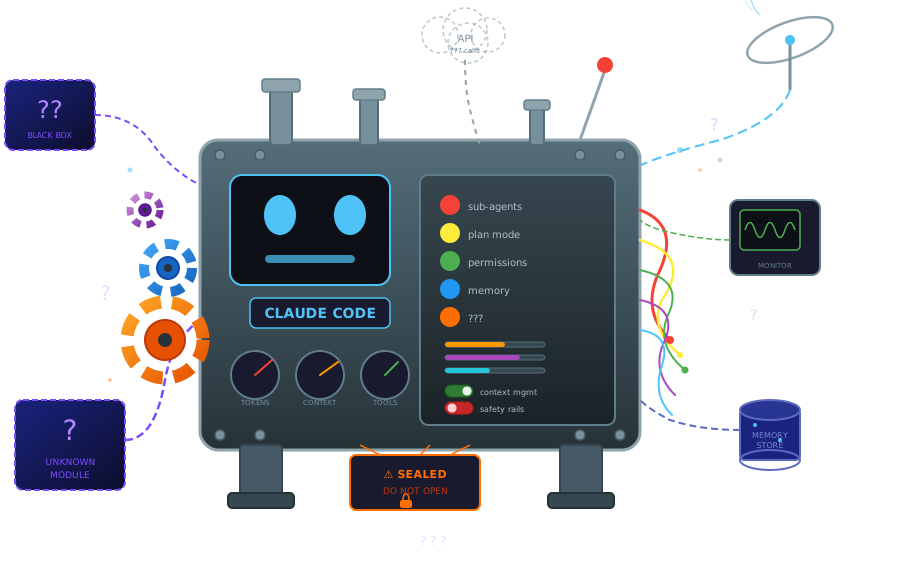
Claude Code: impressive, but…
Polished, powerful, complete
MCP, Sub-agents, plan mode, permissions, memory
Huge engineering effort
The four building blocks
Every coding agent is just:
Model — next-token prediction machine
System prompt — text instructions prepended to every conversation
Tools — JSON schemas the model can "call" (harness executes)
Agentic loop — while/if/else
That’s it. No magic. Let me show you.
The agentic loop
Proof: pi.dev
Same model. 4 tools:
read,write,edit,bash.No MCP, nosub-agents. No plan mode. No permission popups.
~500 word system prompt + Skills + Extensions
Same results. Fraction of the complexity.
Core of OpenClaw
Demo time!
What you need to know
Skills: extend with prose + code
<!-- ~/.pi/agent/skills/code-review/SKILL.md -->
# Code Review
Use when user says "review this" or shares a PR.

## Steps
1. Read the diff or use gh pr diff to get the changes
2. Check for security issues, N+1 queries
3. Summarize findings with severity levels
Auto-discovered. No code. Just markdown.
Share via npm packages or git repos
Works with any model — it’s just prompt text
All relevant coding agents support it
Beyond Skills
Ask pi/claude to write a skill or extension for you
Install extensions from https://skills.sh
Install extensions from https://pi.dev/packages
Context window = working memory
Models have a fixed window (100K-200K tokens)
Everything goes in: prompt + conversation + tool results
When full → agent forgets earlier context
This is why long sessions degrade
Keep tasks focused. Start fresh often.
Why agents hallucinate
The model always generates an answer — no "I don’t know" circuit
Confident tone ≠ correct answer
Sycophantic AI is a problem
This is not a bug. It’s the architecture.
Review like a junior dev wrote it.
Because that’s roughly what happened.
Take home
Patterns that work
Seeing is believing - don’t just read about it, try it out!
Use it for boring stuff — boilerplate, check plans, tests, migrations, docs, regex
Small tasks — "add input validation to page x" not "rewrite auth"
Give context — you know what the model doesn’t, treat it as a new hire
Project rules —
CLAUDE.md/AGENTS.mdwhen needed = cheapest quality boostSkills — teach your agent team-specific workflows
Monday morning
Try Claude Code or pi on a small non-critical task
Have it write a
CLAUDE.md/AGENTS.mdor skill for your taskAdd a Skill for your team’s review checklist
Review AI output like you’d review a junior’s PR
You are still the engineer/builder. The agent is a power tool.
The End!
It’s not magic — it’s a while loop.
Learn how it works. Use it wisely.
@maxandersen
https://maxandersen.github.io/presentations